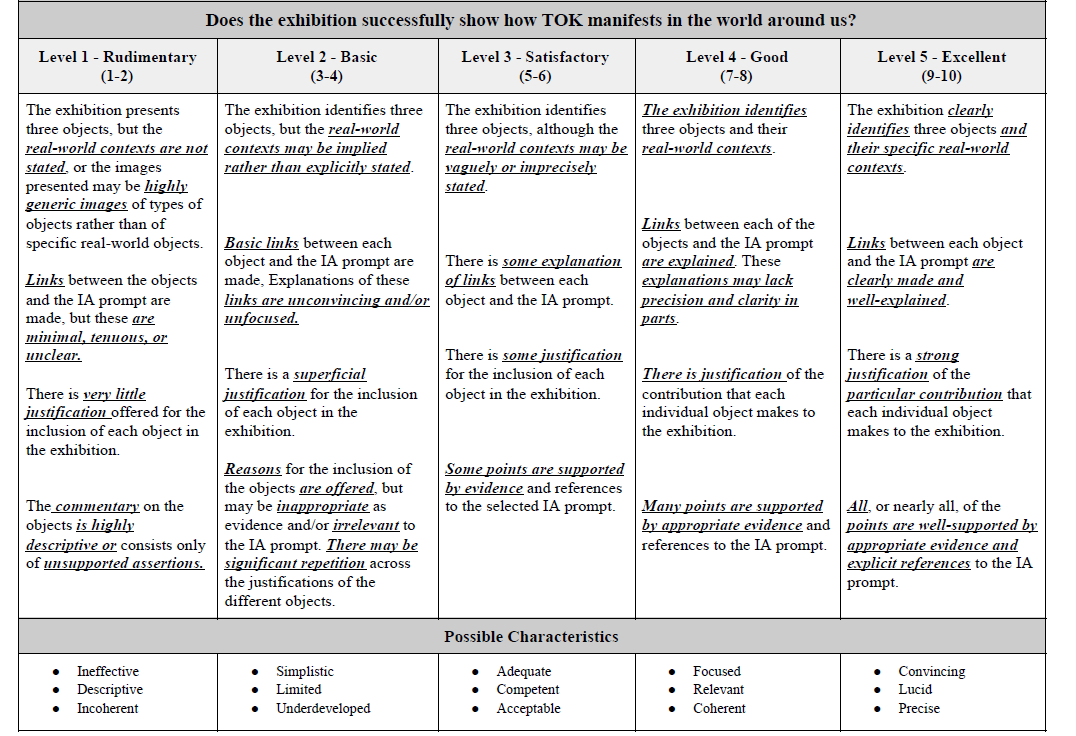
Rubric
Tips
Tips I have been recognising so far:
A picture tells a thousand words... maybe .... but you are asked for an object.
Make sure your object is specific. A calculator belonging to you may be. A Calculator is not.
Remember it is the object and not just what the object stands for that is important. ie. it is about how you relate to the idea.
Remember this is TOK and not TOC (Theory of Couscous) (If I do not see the word knowledge used repeatedly, then I begin to get worried.
If what you are writing is not important to my understanding of how you are relating to knowledge and the knowledge prompt then I do not care!
You should be researching, so we should see evidence of that in a bibliography
Remember the Prompt!
Remember an argument, in order to be convincing you should have considered other views... or should you?
Paragraph Structure
No one can tell you how to structure your paragraph. This said, we can make suggestions. Many students will write in an exploratory manner. ie they will write and then their topic/thesis statement will come out in the final line. This is not a problem...if you writing is a way for you to think. If you are wanting to communicate something it is important that you lead your reader. This will let them understand what you are saying so, your revised paragraph might look more like.:
Thesis Statement (The thing you put in the box!) 20 words
Brief Introduction to object 50 words
Developed statement 100 words
Secondary Developed statement 50 words
Counter statement 50 words
Conclusion 30 words
Further Research
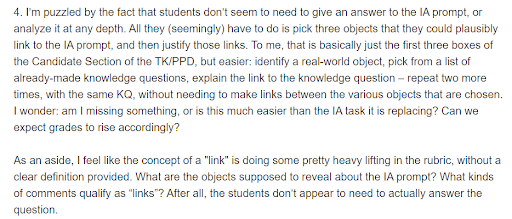 Exhibition Tips/FYIs
 How to Structure a Theory of Knowledge Exhibition
Further thoughts
Object: in a “specific real-world context”
Link to Prompt: The object linked to the IA Prompt clearly Explained
Justification: “This belongs because..” This needs to be well argued and why that specific object belongs in the exhibition.
References: Note that references are required, which means your justification should extend beyond simple logical steps. What evidence might you include?
Look at some of theseexamples. How good are they really?
The following questions may help you:
Is each object clearly set in a specific real-world context?
Do you understand the link to the prompt? (Could you work out the prompt without reading it?)
Is there a clear justification? - How is it made clear?
Does it engage with the prompt’s link to knowledge issues/questions?
Are all points ‘evidenced’ and explicitly linked to the prompt?
Feedback
Image - make sure it is there and is yours... (or clearly referenced)
Lack of context… “a” is a giveaway - this said we have seen top-level answers with an a .... do you want to risk it?
Clear well-argued arguments - Remember PEEL! Examiners do not like a showman approach.
Clear markers required - ‘This belongs in the exhibition...."
Clear, simple language... remember many of your markers will be very pendatic - a) because the are pedants (teachers) and b) because they might well like philosophy which might be argued to be one of the most pedantic of subjects.
Link to your chosen prompt... remember you cannot make your prompt up.
Consider your prompt to be an essay and argue your point
Make sure each deserves to be there in its own right... though they do not have to join together.... they should not repeat ideas and as such should be clearly different in your approach.
Documents for Class of 2023-5
1 Object Exhibition
Previous Exhibition Guidelines